
Artificial Intelligence is rapidly entering classrooms, homes, and everyday learning. New tools promise to support teaching, enhance creativity, and personalize education.
But for many, this raises more questions than answers.
- Which tools are actually useful for my needs?
- Can I trust them?
- How should they be used responsibly?
For teachers, students, and parents, navigating this growing landscape can feel overwhelming.
A guide, not just a tool
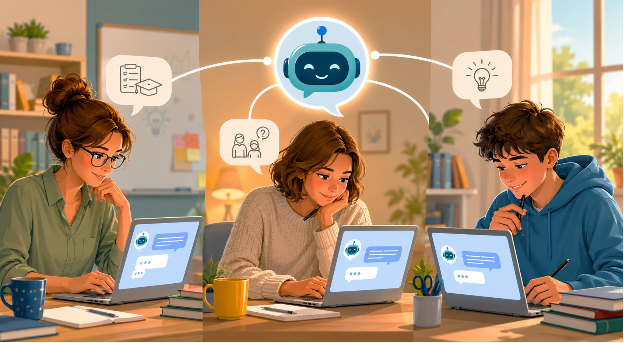
To address this challenge, the GenAI4ED project is developing a chatbot within its platform designed to act as a simple, accessible guide to AI in education. Rather than requiring technical knowledge, the chatbot allows users to ask questions in natural language—just as they would ask a colleague or an expert.
Its role is not to replace decision-making, but to support users in making informed choices.
What can the chatbot help you do in the GenAI4ED platform?
The chatbot supports three key needs:
🕵️ Finding the right tools
Users can describe what they are looking for, and the chatbot suggests relevant Generative AI tools tailored to their needs.
📒 Learning how to use Generative AI in education
The chatbot connects users to a curated training hub with resources designed to support real educational needs—from understanding what Generative AI is, to using it for content creation, assessment, and personalized learning. It provides access to curated educational materials and guidance on the ethical and effective use of AI in learning environments.
🌍 Navigating the platform
It helps users quickly locate resources, tools, and information within the GenAI4ED platform.
What this looks like in practice
A teacher looking for creative ways to strengthen collaboration in the classroom may ask: “How can I use AI to create an escape room activity for my class?”
🤖 The chatbot can suggest tools for generating puzzles, images, hidden clues, and storylines, while also guiding the teacher on how to write effective prompts and structure the activity in a meaningful way. It draws on curated training materials and directs users to specific sections where they can explore prompting techniques and best practices further.
A teacher preparing a lesson might wonder: “How can I create an AI-supported game-based activity for teaching Newton’s laws?”
🤖 The chatbot responds by suggesting relevant tools, explaining how they can be used in practice, and pointing to guidance on responsible classroom use.
A parent supporting his/her teenager at home may ask: “How can I help my child practice solving systems of linear equations using AI tools?”
🤖 The chatbot recommends appropriate tools for guided practice and provides simple explanations and resources to help the parent support learning with confidence.
A student trying to understand a concept may be looking for more intuitive ways to learn: “Which AI tool can help me better understand pendulum oscillation through visualizations?”
🤖 The chatbot recommends tools that provide visualizations and interactive learning experiences, helping the student build a deeper understanding.
Built on trusted knowledge
Guidance and recommendations within the GenAI4ED are based on carefully designed evaluation criteria developed by the GenAI4ED team, taking into account the needs of different users. At the same time, the chatbot is connected to a curated library of educational resources, ensuring that users receive reliable, relevant, and up-to-date information.
Importance
AI has the potential to transform education—but only if people feel confident using it.
By simplifying access to tools, supporting informed choices, and promoting responsible use, the GenAI4ED chatbot aims to bridge the gap between technological potential and everyday educational practice.
The GenAI4ED platform is currently under development, and we look forward to sharing more soon. Stay tuned as we continue building tools that make AI in education more accessible, trustworthy, and meaningful for everyone.
Author(s): Eleftheria Tzamali (FORTH)